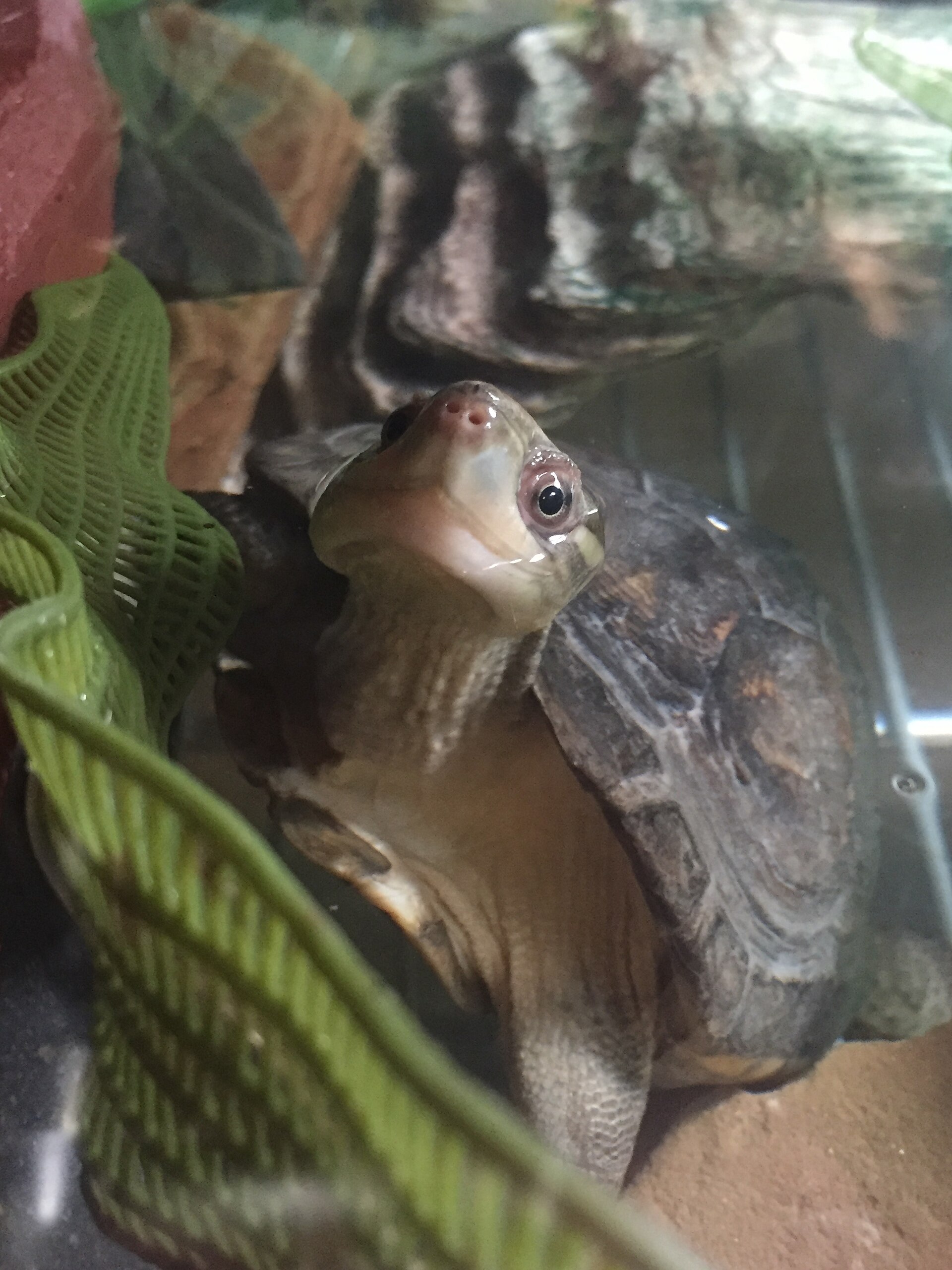
Nobody can tell you a turtle’s age by looking at it, and that includes a vet. The rings on the shell are the method everyone has heard of, and they work for a few years and then stop working. What you can get is a bracket: hatchling, growing juvenile, young adult, or old adult. For most owners that bracket is enough to plan the next few decades.
Why the rings fail
Each large plate on the shell is a scute. When a slider grows, a new, larger layer of keratin forms under the old one and the edge of the new layer leaves a line in the scute. The University of Michigan’s Animal Diversity Web puts it plainly: those lines can be used to age a slider until it is about 4 years old, after which wear on the shell makes them too hard to read. Growth also slows sharply once a turtle reaches sexual maturity, so the lines bunch up and blur even where the shell is not worn.
The lines also do not mark years. A turtle fed well in a warm tank can lay down several in a year. One kept cold or short of food can lay down none. VCA Hospitals tells its clients that the number of rings on the scutes has nothing to do with the turtle’s age. Count them if you like, but write the number down as a guess, not a birthday.
What works better
- Paperwork. A breeder sells a four-inch slider at roughly a year old, so the sale date gives you a hatch year. Keep the receipt.
- Size and sex. A male red-eared slider matures at 2 to 5 years and a female at 5 to 8 years, when her shell is 6 to 8 inches long. A slider with a long tail and long front claws that is still under 4 inches is a juvenile male. A 10-inch female is at least 8 years old and probably older.
- Growth rate. Box turtles grow fast for their first 5 years, then slow down and reach maturity. Young sliders do the same. If your turtle adds half an inch or more a year, it is young. If it has not grown in two years, it is an adult.
- Shell condition. Old turtles have smooth, worn scutes with no visible lines at all, often with old chips and scars. A shell with sharp, crisp rings is a young shell.
A rough table
| What you see | Likely age |
|---|---|
| Red-eared slider under 4 inches | Under 2 years |
| Slider 4 to 6 inches, crisp rings | 2 to 5 years |
| Slider over 8 inches, rings blurred | 8 years or more |
| Box turtle with rings worn smooth | 15 years or more, possibly far more |
How long they live
The Merck Veterinary Manual gives 70 years for some aquatic turtles and up to 150 years for some tortoises. Animal Diversity Web records a captive slider at 41.3 years and notes that wild sliders reach about 30. Box turtles routinely pass 40 in good care. A turtle that is old when you get it is still likely to outlive the tank you bought for it, so plan the housing for the adult size, not the current one.
When age matters for care
Age matters less than size. A 6-inch turtle needs 60 gallons of water whether it is 3 or 13. The exceptions are the two ends of life. Hatchlings under a year need water at 78 to 80°F, a feed every day and a close eye on the shell for softness. Old adults eat less, bask longer and should be weighed every month, because a slow drop in weight is the first sign of kidney or liver trouble a vet can still do something about.
When to see a vet
You do not need a vet to age a turtle, and X-rays will not do it either. Go if the turtle has stopped growing before it reached adult size, which points at cold water, poor diet or no UVB rather than age, or if an adult is losing weight. The vet will weigh it, look at the shell and eyes, check a stool sample for parasites and, for a thin adult, run bloodwork.
What helps
A digital probe thermometer, because a young turtle that is not growing is almost always a cold one. A UVB 10.0 T5 HO fixture and tube so the shell hardens as it grows. Cuttlebone floating in the tank for calcium on demand. The vet directory lists reptile vets by state.
Sources
- Animal Diversity Web, Trachemys scripta (University of Michigan)
- Animal Diversity Web, Terrapene carolina (University of Michigan)
- VCA Hospitals, Owning an Aquatic Turtle
- Merck Veterinary Manual, Description and Physical Characteristics of Reptiles
Written from these and checked three times before publishing. Not veterinary advice; a reptile vet who can see the animal beats any page.